Increment borers are essential tools for non-destructive sampling of agarwood resin zones. They allow farmers to monitor resin formation, wood density, and quality without cutting down the tree.
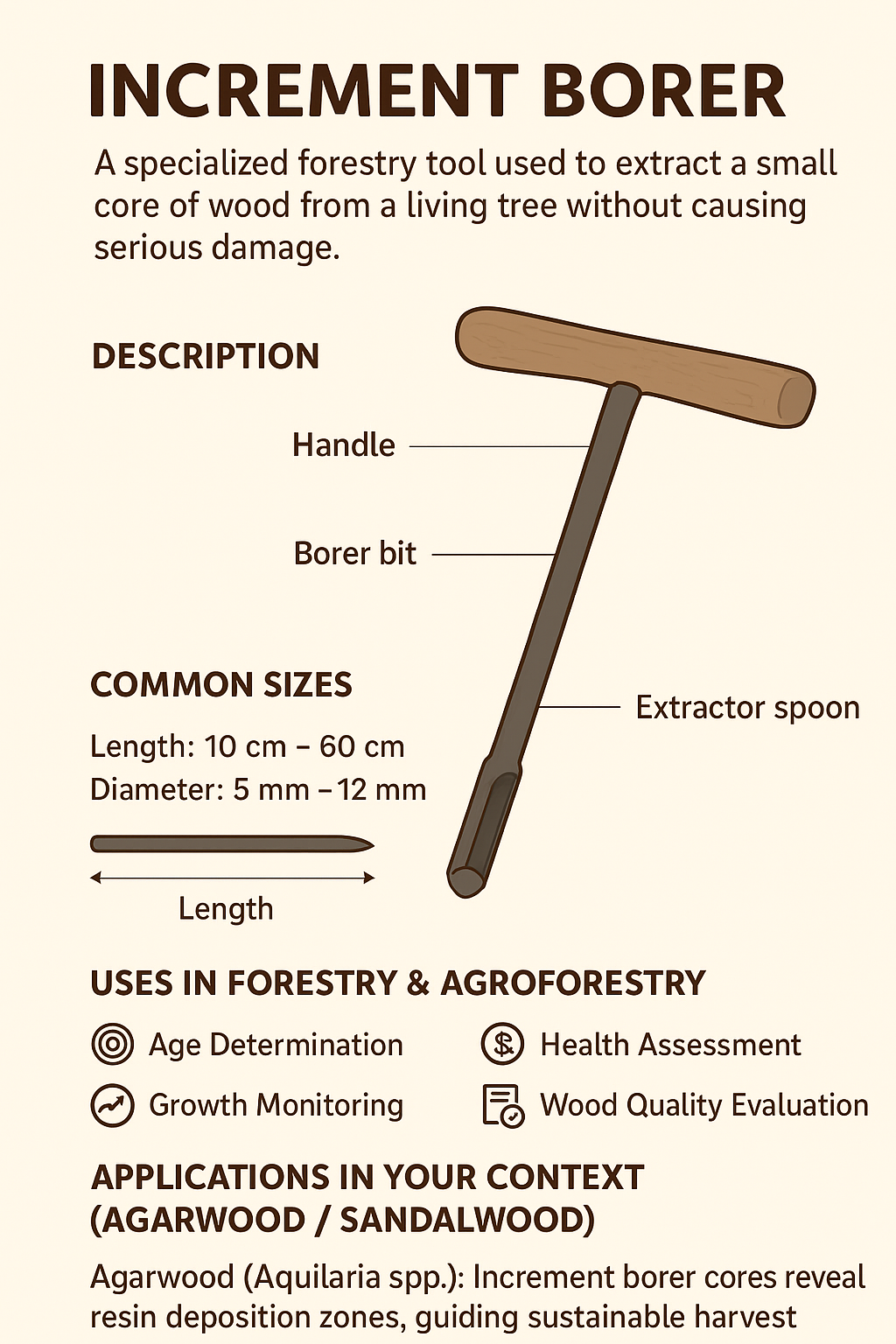
1. What Is an Increment Borer?
- Definition: A hand tool designed to extract a small cylindrical core of wood from a tree trunk or branch.
- Purpose:
- Inspect resin zones
- Measure wood density and color
- Track resin development over time
Think of it as a “wood biopsy tool” for resin monitoring.
2. How to Use an Increment Borer
- Select target wound or resin zone
- Insert borer perpendicular to trunk or branch
- Twist carefully to bore into wood (~2–5 cm depth)
- Extract core slowly to avoid breaking it
- Inspect core for color, resin streaks, and density
- Seal the hole with clay, wax, or stopper to prevent infection
3. Parts of an Increment Borer
| Part | Function |
|---|---|
| Handle / T-handle | Provides leverage to twist the borer |
| Auger / Drill bit | Cuts the wood and creates the core hole |
| Extractor / Core removal tube | Pulls out the wood core without breaking it |
| Depth markings | Helps control drilling depth (usually 2–5 cm for resin zones) |
4. Advantages of Using an Increment Borer
- Non-destructive → tree survives
- Accurate monitoring → resin quality and development
- Portable and easy to use in the field
- Supports data-driven decisions → harvesting time, next induction round
5. Practical Tips for Farmers
✔ Sterilize borer before use to avoid contamination
✔ Drill moderate depth to minimize stress
✔ Limit sampling frequency per tree (e.g., once per 6–12 months)
✔ Combine observations with resin color, smell, and density
✔ Keep records: tree ID, sample location, date, resin stage
Farmer Key Message
“An increment borer is your window inside the tree.
It tells you how much resin formed without harming the tree.”