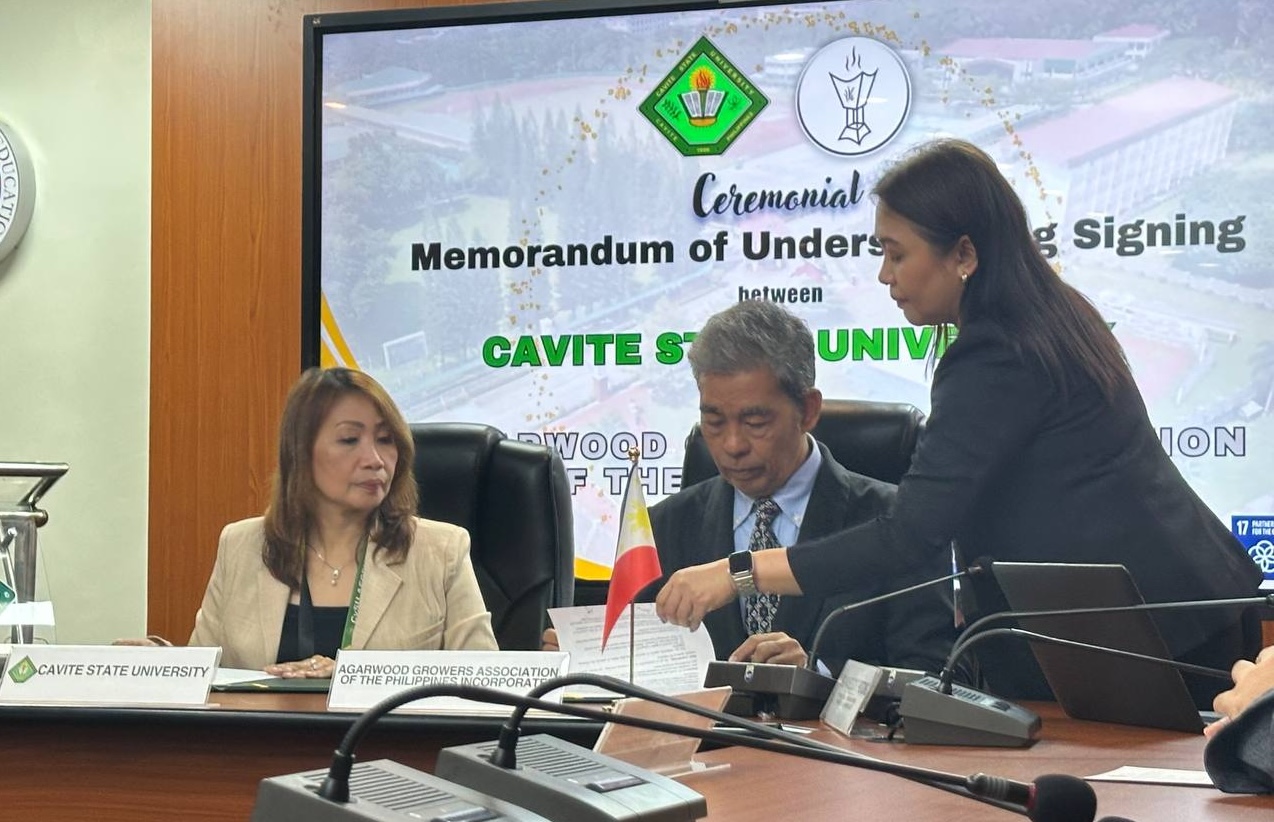
Indang, Cavite, Philippines — Cavite State University (CvSU) and the Agarwood Growers Association of the Philippines Inc. (AGAP) have formally signed a Memorandum of Understanding (MOU) to initiate a long-term scientific and technological collaboration focused on organogenesis propagation, bio-inoculant development, and biofertilizer research for the growing Philippine agarwood industry.
The partnership brings together CvSU’s strong research expertise in agriculture, biotechnology, and plant sciences with AGAP’s nationwide network of agarwood growers, industry practitioners, and field-based innovation platforms.
This MOU marks a milestone in the country’s movement toward science-based, sustainable, and globally competitive agarwood production.
Strengthening Organogenesis & Mass Propagation of Aquilaria
Under the collaboration, CvSU will lead research efforts to refine and scale organogenesis protocols for Aquilaria malaccensis and other perfumery crops. The research program aims to:
• Improve survivability and rooting efficiency
• Enhance clonal fidelity and genetic stability
• Reduce propagation costs through refined media formulations
• Create mass-production pathways for consistent, high-quality planting materials
• Establish a university-industry model for tissue culture commercialization
“This partnership empowers CvSU to translate academic research into real-world agricultural impact,” said CvSU project leads during the signing ceremony.
Joint Development of Agarwood Bio-Inoculants
CvSU and AGAP will also collaborate on bio-inoculant research aimed at improving sustainable resin induction. The project will explore:
• Fungal and microbial strains beneficial to resin formation
• Biological inoculation pathways and host-pathogen interactions
• Safety, efficacy, and optimized application protocols
• Side-by-side comparisons with chemical and hybrid induction methods
• Field validation through AGAP’s nationwide member farms
AGAP emphasized that this initiative will pave the way for ethical, science-verified, and legally compliant agarwood production across the Philippines.
Biofertilizer Research for High-Value Trees
The partnership further expands into the development of biofertilizers that support the long-term growth, vigor, and environmental resilience of agarwood and related forestry crops. Research areas include:
• Formulation of nutrient-enhancing microbial consortia
• Soil microbiome enhancement strategies
• Climate-smart fertilization systems
• Field trials in diverse agroecological conditions
• Integration into sustainable agroforestry frameworks
These biofertilizers aim to reduce growers’ dependence on chemical inputs while improving yields and ecological outcomes.
A Unified Vision for a Sustainable Agarwood Sector
CvSU and AGAP share a mission to uplift the Philippine agarwood industry by merging academic excellence, scientific integrity, and farmer-level capacity building.
Through this MOU, both institutions commit to:
✓ Advancing national research leadership in perfumery crops
✓ Providing farmers with reliable, science-backed technologies
✓ Supporting regulatory compliance and sustainable practices
✓ Developing future-ready biotech solutions for the forestry and wellness industries
✓ Strengthening the value chain from propagation to production
About Cavite State University (CvSU)
CvSU is a premier agricultural and science university dedicated to research, innovation, and community development across multiple campuses in Cavite.
About AGAP
The Agarwood Growers Association of the Philippines Inc. (AGAP) is a national organization committed to sustainable agarwood cultivation, training, regulatory compliance, and industry advancement.