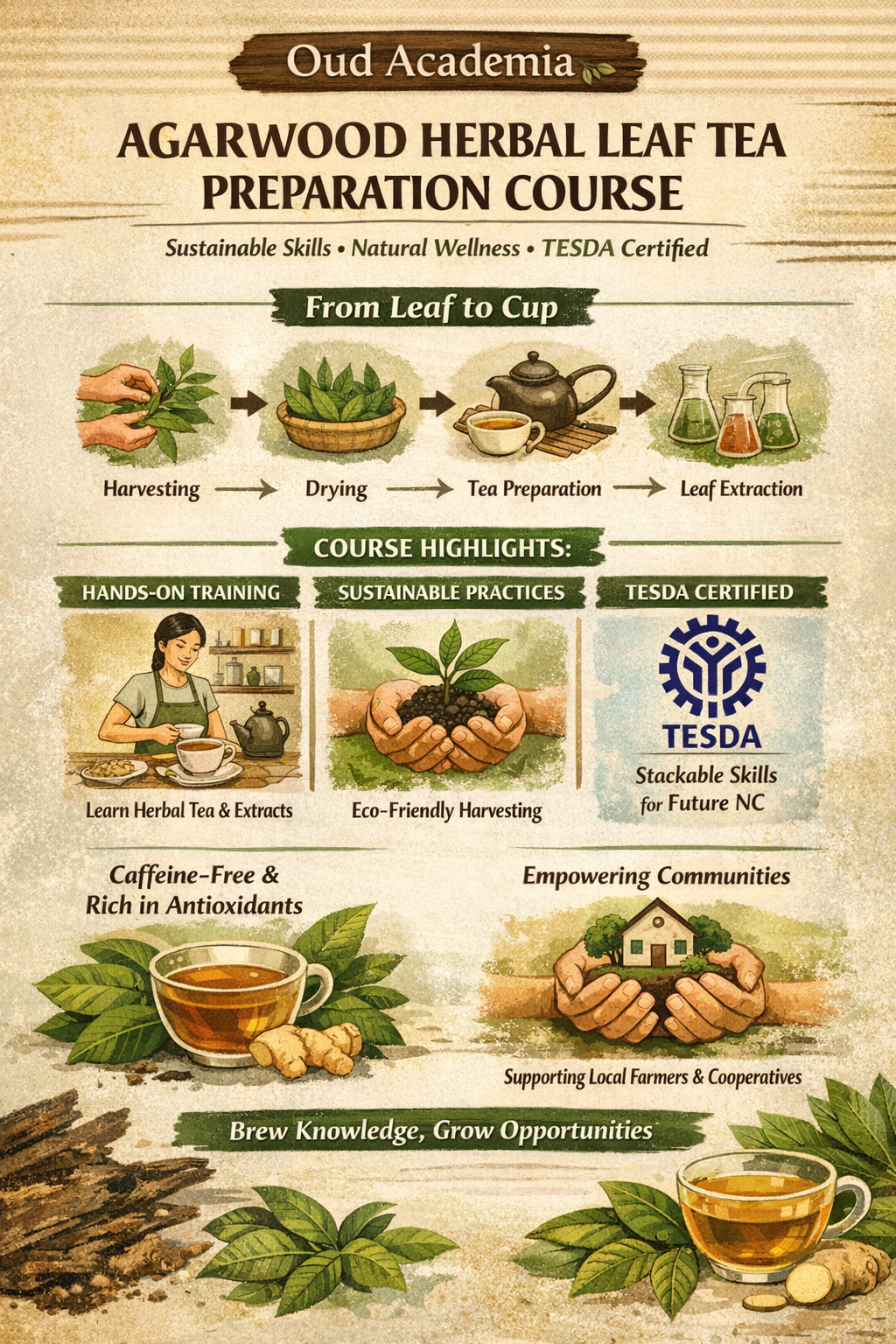
Our Heritage & Vision. At Oud Academia, we honor the centuries-old legacy of agarwood, long treasured across Asia for its aromatic and cultural significance. While the world knows agarwood for its resin, we believe its leaves hold untapped potential—a sustainable, gentle, and aromatic herbal resource that supports wellness, learning, and community livelihoods.
The Journey from Leaf to Cup. Our Agarwood Herbal Leaf Tea Program transforms the humble leaf into a premium botanical infusion, blending tradition, science, and sustainability. Learners experience every step of the process:
- Sustainable Harvesting: Respecting the tree, the forest, and local ecosystems.
- Post-Harvest Handling: Preserving freshness, aroma, and quality.
- Extraction & Brewing: Mastering the art of herbal tea preparation and non-resin leaf extracts.
- Packaging & Labeling: Understanding regulatory-safe, market-ready practices.
Empowering Learners & Communities. Oud Academia’s program goes beyond tea—it is a gateway to skill-building, livelihood creation, and agroforestry entrepreneurship. By teaching learners how to safely process agarwood leaves, we equip them with competencies stackable toward future TESDA National Certificates, fostering economic opportunity and sustainability.
Sustainability at the Core. Every cup of agarwood leaf tea we prepare embodies responsibility and care:
- Leaves are harvested without harming trees, ensuring long-term forest health.
- Practices are aligned with TESDA standards, food safety, and regulatory compliance.
- The program encourages ethical community engagement, empowering cooperatives and farmers.
A Unique Experience. More than a training course, the Agarwood Herbal Leaf Tea program is a sensory and educational journey. Learners leave with not just technical knowledge, but a deeper appreciation for botanical science, cultural heritage, and sustainable business.
Our Promise. At Oud Academia, we brew more than tea—we cultivate knowledge, skills, and opportunity. Every leaf prepared, every cup steeped, is a step toward sustainable livelihoods and a richer understanding of the world of agarwood.
Professional Training Course – Module Syllabus
Carrier Institution: Oud Academia
Academic Arm: Crown Institute for Agarwood Science, Art & Sustainable Enterprise (CI-ASASE)
Course Type: Professional Certificate / TESDA-Ready Short Course
Total Duration: 24–30 hours (3–4 days intensive or modular delivery)
MODULE 1 — Agarwood Leaf Science & Ethnobotany
Learning Objectives:
- Understand agarwood beyond resin: leaf biology and phytochemistry
- Distinguish tea-grade leaves from non-food biomass
Topics:
- Aquilaria spp. leaf anatomy & growth stages
- Traditional use of agarwood leaves (Japan, Vietnam, Thailand, China)
- Comparison: resin vs leaf metabolite profiles
- Bioactive compounds:
- Mangiferin
- Flavonoids
- Polyphenols
- Antioxidant fractions
- Food vs non-food plant parts (regulatory distinction)
Practical:
- Leaf identification: mature vs young vs stressed leaves
MODULE 2 — Ethical Harvesting & Sustainable Leaf Collection
Learning Objectives:
- Apply sustainable leaf harvesting protocols
- Maintain tree health and plantation productivity
Topics:
- Pruning ethics for Aquilaria
- Seasonal timing & leaf maturity index
- Yield optimization without growth suppression
- Agroforestry-compatible harvesting
- Traceability: batch coding & harvest logs
Practical:
- Field harvesting simulation
- Harvest record documentation
MODULE 3 — Food Safety, Compliance & Regulatory Standards
Learning Objectives:
- Produce agarwood leaf tea compliant with food standards
Topics:
- Food-grade vs medicinal classification
- Philippines context:
- FDA (food product classification)
- BFAD legacy standards
- ASEAN & export considerations
- Contaminant risks:
- Heavy metals
- Pesticides
- Mycotoxins
- Hygiene, sanitation & worker safety (GMP basics)
- Allergen and labeling considerations
Practical:
- Hazard Identification Exercise (HACCP-lite)
MODULE 4 — Post-Harvest Leaf Processing Techniques
Learning Objectives:
- Convert raw leaves into high-quality tea-grade material
Topics:
- Washing & sanitation protocols
- Withering vs direct drying
- Drying methods:
- Sun-drying (controlled)
- Cabinet dryer
- Low-temp dehydrator
- Enzymatic oxidation control (green vs semi-fermented profiles)
- Moisture content standards (<8–10%)
- Color, aroma & texture benchmarks
Practical:
- Hands-on drying comparison
- Moisture testing & visual grading
MODULE 5 — Agarwood Leaf Tea Formulation & Blending
Learning Objectives:
- Create safe, consistent, and market-ready tea blends
Topics:
- Single-origin agarwood leaf tea
- Functional blends (non-medical):
- Agarwood + pandan
- Agarwood + lemongrass
- Agarwood + ginger
- Cut size & particle uniformity
- Sensory balance: bitterness, aroma, finish
- Avoiding prohibited medicinal claims
Practical:
- Blend formulation workshop
- Sensory cupping & scoring
MODULE 6 — Brewing Science & Sensory Evaluation
Learning Objectives:
- Standardize brewing protocols for quality assurance
Topics:
- Water quality & mineral content
- Leaf-to-water ratios
- Temperature & steeping time optimization
- Cold brew vs hot infusion
- Aroma release mechanics
- Sensory descriptors & profiling
Practical:
- Controlled brewing trials
- Professional tea tasting panel exercise
MODULE 7 — Packaging, Shelf Life & Storage
Learning Objectives:
- Preserve quality and safety from factory to consumer
Topics:
- Packaging options:
- Loose leaf
- Tea bags
- Pyramid sachets
- Moisture & oxygen barriers
- Desiccants & nitrogen flushing
- Shelf-life testing basics
- Storage conditions (humidity & light control)
Practical:
- Packaging mock-up & labeling exercise
MODULE 8 — Branding, Market Positioning & Ethics
Learning Objectives:
- Position agarwood leaf tea correctly in the wellness market
Topics:
- Cultural sensitivity in agarwood branding
- Food vs wellness narratives
- Ethical sourcing & community stories
- Pricing strategies (local vs export)
- Export readiness checklist
Practical:
- Brand story drafting
- Product positioning exercise
MODULE 9 — Business Models & Small-Scale Commercialization
Learning Objectives:
- Turn agarwood leaf tea into a viable enterprise
Topics:
- Farm-to-cup value chain
- Costing & margin analysis
- Cooperative & contract-farming models
- Private label vs own brand
- Integration with agarwood plantations
Practical:
- Mini business canvas
- Cost & pricing worksheet
MODULE 10 — Assessment & Certification
Assessment Components:
- Practical:
- Leaf processing demonstration
- Brewing & sensory evaluation
- Written:
- Food safety & compliance quiz
- Project:
- Market-ready agarwood leaf tea concept
Certification:
- Certificate in Agarwood Herbal Leaf Tea Preparation (Professional Level)
- TESDA alignment-ready (Competency-Based, Non-NC, Stackable)