Key Producing & Exporting Countries in ASEAN
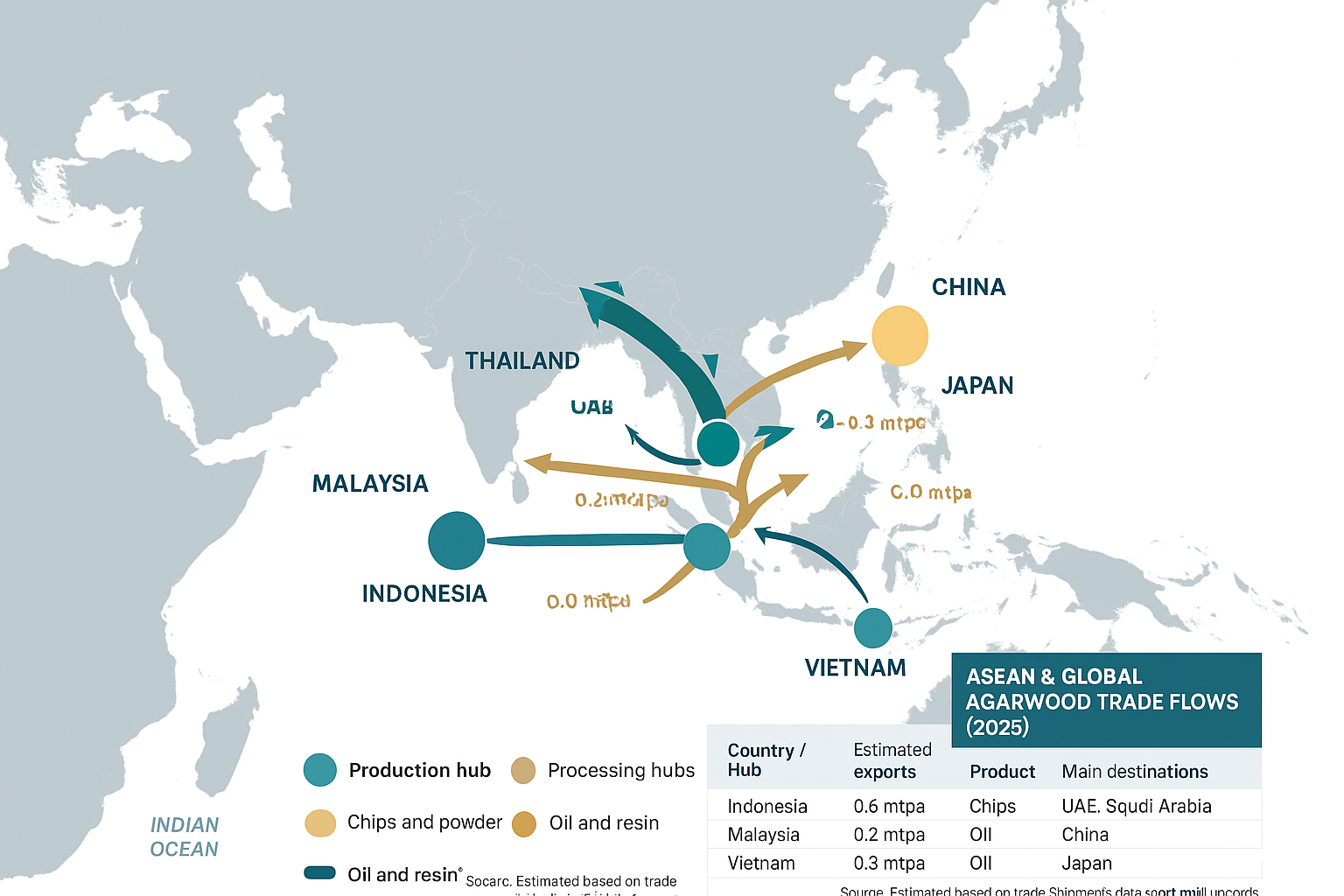
- Indonesia — Widely accepted as the single largest supplier of agarwood globally. Its abundant natural forests (Java, Sumatra, Kalimantan) and expanding plantation development make it the leading exporter.
- Malaysia — Another major exporter; produces agarwood chips and essential oils. Government-supported sustainable plantations and regulated (often CITES-compliant) trade practices help maintain its export capacity.
- Vietnam — Increasingly important for cultivated agarwood and oil production; also active in trade and export especially for processed oud oil.
- Cambodia, Laos, Thailand, and smaller producers in the region — contribute through smaller-scale production (wild or plantation), chips, wood, or oils. Cambodia and Laos, for instance, supply chips which are often routed through transit hubs elsewhere.
- Philippines — Emerging as a player, especially in plantation-based production and R&D-driven agarwood cultivation, oil extraction, and value-added supply chains.
Key Regional Trade / Processing / Transit Hubs in ASEAN
Some ASEAN locations are not just producers but also act as processing or transit centers — facilitating value-addition, export logistics, certification, and re-export. Notable hubs:
| Hub & Country | Role & Strength |
|---|---|
| Bangkok (Thailand) | Regional processing, trading, and blending hub. Many incense, oud-oil, and perfume operations are centered here. |
| Ho Chi Minh City (Vietnam) | Export center; increasingly leveraging traceability (e.g. blockchain pilot for agarwood) — useful for premium buyers concerned with origin & sustainability. |
| Penang / parts of Malaysia | Home to quality testing and essential-oil refinement facilities, supporting the region’s high-grade output. |
| Other logistics/export nodes (Indonesia, Malaysia, Thailand, Vietnam, Philippines) | Serve as raw-material collection, processing (chips/oil), and export terminals — often supplying the major global import markets. |
Why This Matters for You
Given your business plans — especially plantation-based production, extraction and processing, and essential-oil/perfumery business — these ASEAN hubs provide a credible baseline. You’re well-positioned if you:
- Ensure sustainable, traceable, and CITES-compliant supply (since wild-harvested agarwood faces regulations). (IUCN Portals)
- Leverage value-adding processing and refinement (oil extraction, purification, certification), rather than just raw chips — this aligns with what big buyers seek (refined oil, quality consistency).
- Connect with regional trade/processing hubs (e.g. through partnerships, export logistics, or regional offices) to facilitate exports from the Philippines to Middle East, East Asia, etc.
International Trade & Consumption Hubs (Import / Re-export / Final Demand Markets)
Beyond ASEAN, several global regions and nodes play a critical role in the agarwood / oud trade as importers, re-export centers, or final-consumer markets:
- United Arab Emirates (especially Dubai) — Often cited as the largest regional trading hub for agarwood and oud oil in the Middle East. Many shipments from ASEAN exporters pass through Dubai before distribution to the Gulf and broader Middle East.
- Other Gulf / Middle East countries — including Saudi Arabia, Qatar, Kuwait, Bahrain, Oman. These remain major consumers — for perfume, incense, religious/cultural use, and luxury fragrances.
- East Asia — China, Hong Kong, Japan, and parts of South Korea — large historic consumption demand (incense, traditional medicine, culture), and increasing demand for luxury oud oils and perfumes. China and Hong Kong also often serve as re-export or redistribution points.
- Western markets (Europe, North America) — smaller in volume compared to Middle East / Asia, but growing demand for sustainable, certified, and high-quality oud oils especially in niche perfumery, luxury fragrance houses, wellness & aromatherapy sectors.
Structure of Global Trade Network — Flow Patterns & Roles
From the literature and recent trade analyses:
- Raw agarwood (chips, wood) tends to flow from producing countries in Southeast/South Asia to processing or consumption hubs in Middle East, East Asia, and occasionally re-export centers like Hong Kong / Singapore / UAE. (CITES)
- Some countries in ASEAN (like Vietnam, Malaysia, Thailand) function as both source and transit/processing nodes — i.e. they may import agarwood (or receive from nearby range countries like Laos, Cambodia), process or refine it, and then export to high-demand markets.
- The network is highly connected: studies identify Indonesia as the most central player (largest number of trade links), but Vietnam, Malaysia, Thailand show high “centrality” because they connect producers with global markets and act as bottlenecks/bridges.
- Due to regulatory pressure and sustainability concerns, there’s a growing shift toward plantation-origin, CITES-compliant agarwood — especially for export. (CITES)
Strategic Lessons for Your Business
- Position the Philippines as a sustainable/traceable exporter, tapping growing demand in Middle East and East Asia for certified plantation-based agarwood (especially oil and high-quality chips).
- Develop partnerships or trade links with major trade hubs — especially Dubai (UAE), Hong Kong/Singapore, and key import markets in Middle East / East Asia — to facilitate export, re-export, or redistribution.
- Consider processing and value-addition locally (oil extraction, quality control, certifications) to avoid exporting solely raw chips. This can capture more value and align with premium-market demand for refined/high-quality oud.
- Leverage transit countries/hubs in ASEAN (e.g. Vietnam, Malaysia, Thailand) for logistics, blow-by-blow supply chain access, or sourcing / pooling wood from neighboring countries (Laos, Cambodia) — but ensure regulatory compliance and transparency for ethical sourcing.
- Emphasize sustainability, traceability, and certification (CITES compliance, possibly blockchain traceability)as key differentiators — given rising global scrutiny and buyer preference for “sustainably-sourced, ethical” products.