1. SITE SELECTION FOR AGARWOOD PLANTATIONS
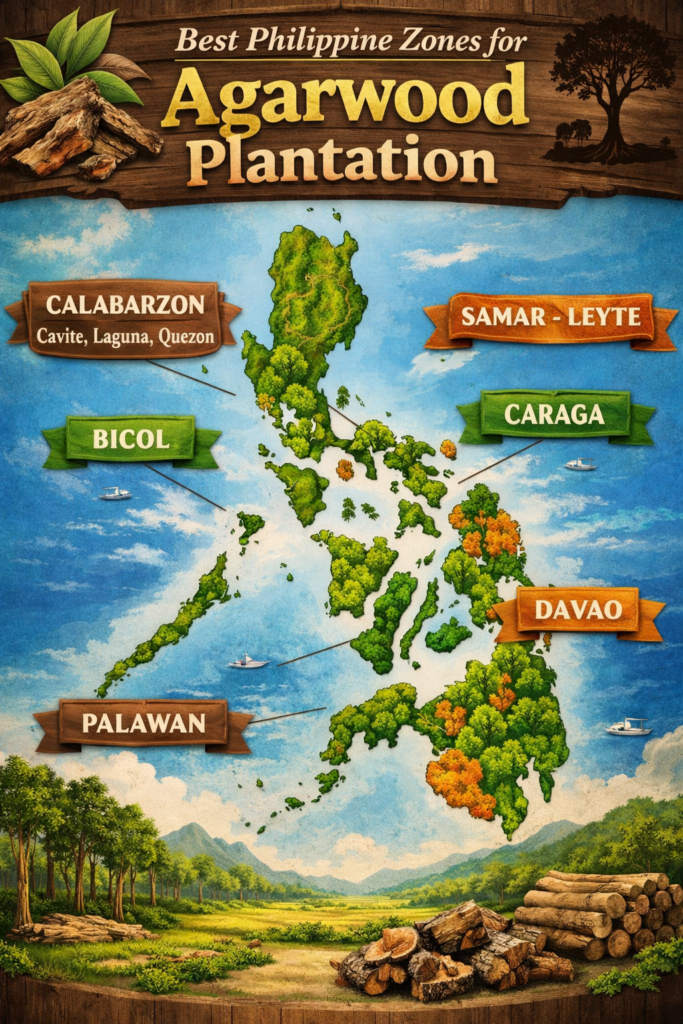
Selecting the right site determines resin yield, tree health, survival rate, and long-term profitability.
A. Optimal Climate Conditions
- Temperature: 22–32°C
- Rainfall: 1,500–3,500 mm annually
- Humidity: >60% ideal for seedling and young trees
- Elevation: Sea level to 700 masl
- Sunlight: Full sun (6–8 hrs/day), tolerates partial shade in early growth
Best Philippine Zones:
- CALABARZON (Cavite, Laguna, Quezon)
- Bicol
- Samar–Leyte
- CARAGA
- Davao
- Palawan
B. Soil Requirements
- Texture: Loamy-sandy loam; well-drained
- pH: 5.5–6.5 (slightly acidic)
- Organic Matter: ≥3% improves growth and resin induction
- Slope: 0–30% (gentle slopes preferred)
- Drainage: Must be excellent; waterlogging reduces survival
Soil Indicators for Good Sites:
- Earthworm activity
- Dark topsoil
- Porous texture
- Rich leaf litter
- Natural undergrowth
Soil Problems & Solutions:
| Problem | Cause | Solution |
|---|---|---|
| Too alkaline (pH >7) | Limestone soils | Add compost, organic acids |
| Waterlogging | Heavy clay | Raised beds, drainage canals |
| Low fertility | Depleted soils | Apply COBI organic fertilizers, compost tea |
C. Accessibility & Infrastructure
- Reliable road access (for transport of logs/chips/oil)
- Water source nearby (creek, deep well, rainfall catchment)
- Potential for solar-powered pumps
- Security: Clear boundaries, fencing, community involvement
- Proximity to processing hubs: Distillation facility or CESI extraction site
2. SPECIES CHOICE FOR AGARWOOD PLANTATIONS
Different Aquilaria species influence resin yield, growth speed, and market grade.
1. Aquilaria malaccensis
- Primary species in Philippines & Southeast Asia
- Fast growth, high resin yield potential
- Most accepted in GCC markets
- Best for chips and oil
Species Selection Matrix (Simple)
| Market Target | Best Species |
|---|---|
| Chips (GCC) | A. malaccensis |
| Mixed agroforestry | A. malaccensis |
3. AGROFORESTRY INTEGRATION MODELS
Agroforestry reduces risk, maximizes land productivity, and enhances biodiversity.
Below are proven models suitable for Philippine conditions.
A. Intercropping Models (Years 1–3) – Ideal for early-stage plantations when Aquilaria is still small.
- Short-term intercrops
- Ginger
- Turmeric
- Pineapple
- Peanuts
- Legumes
- Coffee (under partial shade)
Benefits:
- Cash flow during early years
- Soil cover & weed suppression
- Adds organic matter to soil
B. Companion Trees (Long-term Integration) – These species pair excellently with Aquilaria and enhance agroecology.
- Nitrogen-Fixing Trees (Supports Aquilaria Growth)
- Pterocarpus indicus (Narra)
- Erythrina variegata (Dapdap)
- Gliricidia sepium (Madre de cacao)
- Leucaena leucocephala (Ipil-ipil)
- Sesbania grandiflora (Katuray)
Benefits:
- Natural soil fertility improvement
- Shade during early years
- Biomass for mulch
2. High-Value Tree Companions
Sandalwood (Santalum album)
- Extremely high-value wood
- Complementary canopy height
- Combines well with agarwood oil extraction for CESI
Ylang-ylang (Cananga odorata)
- Fast income (flower harvesting)
- Continuous harvest
- Supports ANOC perfumery operations (Ethereal Scent)
Cinnamon & Nutmeg
- Shade-providing
- Dual or triple revenue streams
- Compatible soil conditions
Golden Champaca (Michelia champaca)
- High-value perfumery flower
- Shade partner
- Adds biodiversity
3. Fruit Tree Integration
- Calamansi
- Lanzones
- Rambutan
- Coconut (on coastal sites)
Benefits:
- Resilient diversified income
- Microclimate improvement
- Pollinator attraction
C. Agroforestry Layout Models
Model 1: Strip Planting (Most Common)
Agarwood rows alternated with:
- Nitrogen-fixing trees
- Ylang-ylang
- Cinnamon
Layout:
N-fixer | Agarwood | Agarwood | Ylang-ylang | Agarwood | Cinnamon
Model 2: Cluster Agroforestry
Ideal for mixed income:
Clusters of:
- 25–50 Aquilaria
- 10–20 sandalwood
- 10 fruit trees
- Understory herbs
Model 3: Multistory Forest Model
Mimics natural forest structure.
| Layer | Species |
|---|---|
| Upper canopy | Fruit trees |
| Midstory | Ylang-ylang, sandalwood |
| Understory | Aquilaria |
Model 4: Integrated Plantation + Distillation Node
- Aquilaria blocks
- Oil-bearing plant blocks (ylang-ylang, champaca)
- On-site distillation building
- Nursery + compost area
- Demonstration plots for agroforestry training
4. Site–Species–System Matching Table
| Site Condition | Best Species | Best Agroforestry Model |
|---|---|---|
| High rainfall, fertile | A. malaccensis | Multistory + fruit trees |
| Sloping terrain | A. malaccensis | Cluster agroforestry |