1. Purpose of Core Sampling
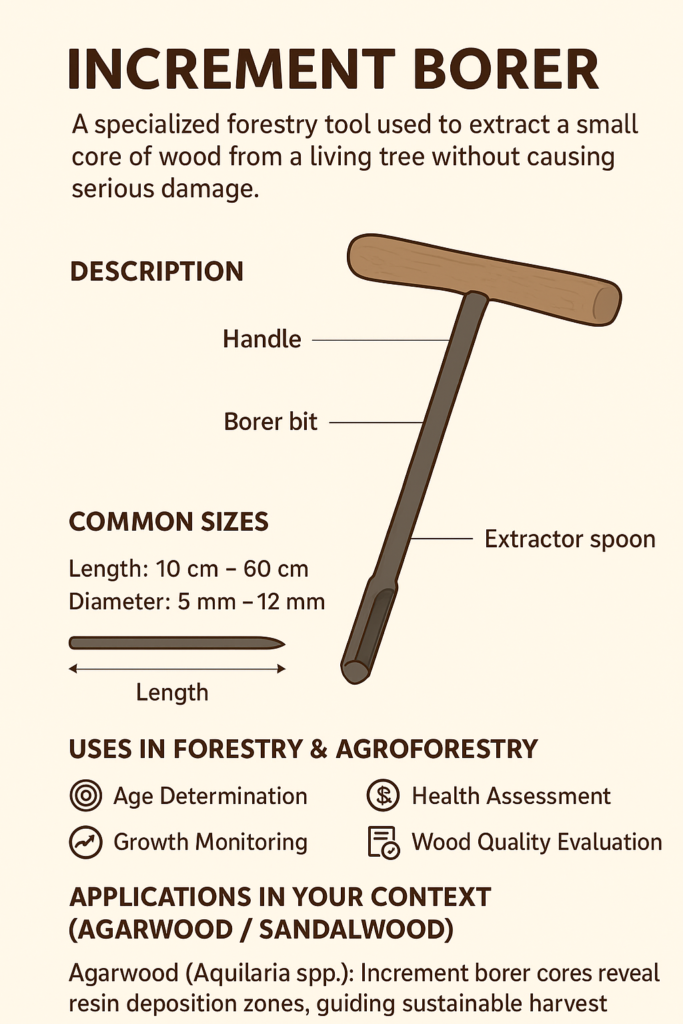
Core sampling is a non-destructive or minimally invasive method to:
- Detect the presence, location, and extent of resin in standing trees.
- Estimate resin quality and density before harvesting.
- Monitor resin development over time in plantations.
It allows growers to make informed decisions without felling the tree.
2. Equipment Needed
- Increment borer (small diameter): 5–10 mm core bit.
- Hammer or T-handle: To drive the borer into the trunk.
- Core extractor or needle: To remove the wood sample.
- Marking tape or chalk: For marking sampling points.
- Plastic bags or vials: To store cores.
- Notebook or digital recording device: To document findings.
3. Sampling Procedure
- Select Sampling Height & Sites
- Typically 0.5–1.5 m above ground (breast height).
- Sample multiple points around the trunk (north, south, east, west) for representativeness.
- Avoid sampling too close to large wounds or infection sites unless specifically monitoring resin development there.
- Drill the Increment Borer
- Insert borer slowly into the trunk, ideally perpendicular to the growth rings.
- Drill until reaching the pith or desired depth (usually 10–20 cm).
- Avoid over-drilling, which may stress the tree.
- Extract Core
- Rotate the extractor or use the borer’s wedge to carefully remove the core.
- Handle cores gently to avoid breakage or contamination.
- Inspect Core for Resin
- Discoloration: Dark brown to black streaks indicate resin zones.
- Texture/density: Resinous portions are harder, sometimes sticky.
- Scent: Crush or sand a small portion to detect aromatic compounds.
- Record Observations
- Note tree ID, location, sample height, resin presence, color, and estimated density.
- Photograph cores for reference.
- Seal Boring Holes
- Apply tree wound sealant or natural clay to prevent infection or pest entry.
4. Advantages
- Non-destructive: Tree can continue producing resin.
- Early detection: Identify resin zones before cutting.
- Repeatable: Same tree can be monitored over time.
- Quantitative assessment: Core diameter, length, and resin proportion can be measured.
5. Limitations
- Small cores may miss localized resin pockets.
- Requires skill to interpret core color and density accurately.
- Trees may respond with minor wounds; repeated sampling should be spaced appropriately.
6. Best Practices
- Combine core sampling with visual inspection and scent testing for accuracy.
- Use sanitized tools to avoid spreading fungi or pathogens.
- Mark sampled sites to avoid repeated stress in the same area.
- For plantations: consider periodic monitoring (6–12 months) to track resin induction progress.