Sustainable Extraction of Essential Oils from High-Value Perfumery Crops
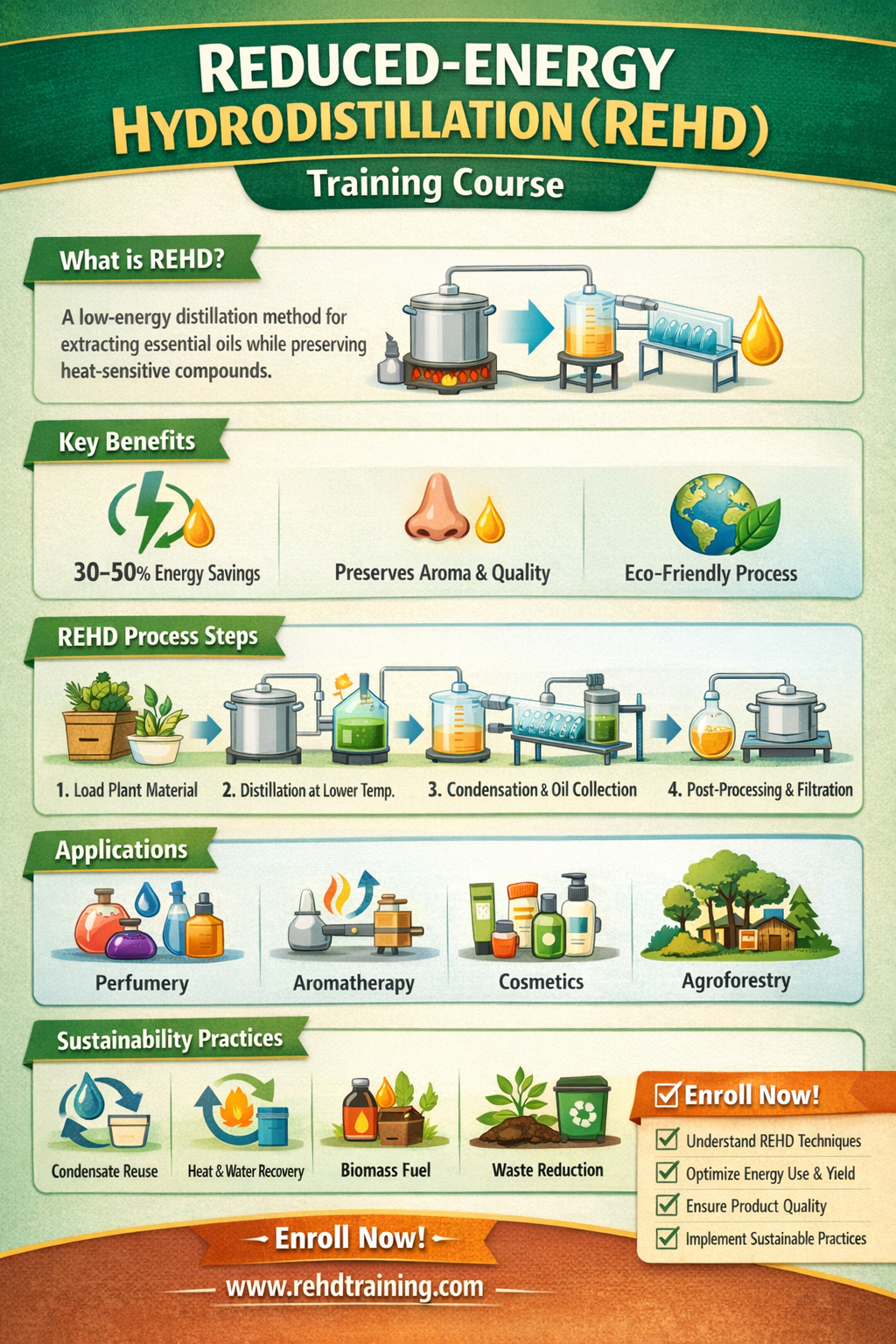
The REHD Training Course empowers farmers, entrepreneurs, and researchers to produce premium-quality essential oils with lower energy consumption and environmental impact. It combines engineering innovation, sustainability principles, and perfumery science to redefine how essential oils are extracted from aromatic crops.
Traditional hydrodistillation and steam-distillation techniques have long been the backbone of essential oil production. Yet, they are often energy-intensive, costly, and environmentally demanding.
REHD introduces a modern, eco-efficient approach, optimizing distillation through:
- Heat recovery systems
- Controlled pressure distillation
- Modular, scalable distillation setups
This hands-on program demonstrates that high-quality oil yields and sustainability can coexist, turning essential oil production into a profitable and responsible practice.
Why This Course Matters
Participants will learn to:
- Reduce energy use while maximizing extraction efficiency
- Design modular distillation systems suitable for small to medium-scale operations
- Maintain essential oil quality while lowering costs
- Integrate sustainability into perfumery and agricultural business models
The course equips learners with the skills to make production greener, more efficient, and commercially viable, addressing both economic and environmental challenges in aromatic crop industries.
“Innovation in Every Drop. Sustainability in Every Process.”
Every participant emerges with practical expertise, hands-on experience, and the confidence to implement energy-efficient distillation systems, contributing to greener production, lower costs, and higher-quality oils.
Course Overview
The Reduced-Energy Hydrodistillation (REHD) Training Course introduces participants to a modern, eco-efficient approach to traditional distillation. This hands-on program demonstrates how optimized hydrodistillation and steam-distillation techniques—enhanced by heat recovery, controlled pressure, and modular distillation systems—can extract premium-quality essential oils with significantly lower energy consumption and environmental impact.
This course integrates engineering principles, sustainability practices, and perfumery science, empowering farmers, entrepreneurs, and researchers to produce natural oils more efficiently and profitably.
Course Duration
- 3 days (intensive, blended learning)
- Lecture and discussion: 40%
- Hands-on laboratory and field demonstration: 60%
Target Participants
- Essential oil producers and small distillery owners
- Agroforestry and agribusiness professionals
- Agricultural engineers and chemists
- Researchers and students in plant sciences or natural product chemistry
- Sustainable product developers and perfumery entrepreneurs
Learning Outcomes
By the end of the course, participants will be able to:
- Understand the scientific principles of hydrodistillation and steam distillation.
- Operate a reduced-energy distillation setup safely and efficiently.
- Optimize temperature, pressure, and time for maximum oil yield and quality.
- Apply heat recovery and water recycling techniques to minimize energy use.
- Compare REHD with other extraction technologies (e.g., Supercritical CO₂ Extraction).
- Analyze oil yield, purity, and aroma profile.
- Integrate REHD methods into sustainable community-based production systems.
Course Modules
Module 1 – Introduction to Essential Oil Extraction Technologies
- Overview of natural oil extraction methods
- Traditional vs. modern hydrodistillation
- Sustainability and energy efficiency in essential oil production
Module 2 – Fundamentals of Hydrodistillation
- Physical and chemical principles of distillation
- Volatility, vapor pressure, and condensation dynamics
- Factors affecting oil yield and composition
Module 3 – Design and Components of REHD Systems
- Boiler and condenser design for energy conservation
- Steam flow control, insulation, and thermal management
- Modular and scalable REHD systems for small to medium enterprises
Module 4 – Process Optimization and Energy Reduction
- Temperature-pressure relationship and distillation kinetics
- Pre-treatment of raw materials (drying, grinding, soaking)
- Reusing condensate and implementing closed-loop systems
- Comparative trials: Traditional vs. REHD energy consumption
Module 5 – Hands-On Practical Session
- Setup and operation of REHD equipment
- Oil collection, separation, and measurement
- Real-time monitoring of energy input and yield output
- Safety protocols and troubleshooting
Module 6 – Quality Evaluation and Applications
- Organoleptic and chemical analysis (aroma, color, purity)
- Product applications: perfumery, aromatherapy, and cosmetics
- Standardization and post-processing of essential oils
Module 7 – Environmental & Economic Benefits
- Carbon footprint reduction through energy-efficient technologies
- Water management and waste minimization
- Economic analysis and return-on-investment of REHD adoption
Module 8 – Commercialization and Scaling Up
- Integrating REHD into agroforestry and cooperative models
- Market potential for sustainably extracted essential oils
- Branding, packaging, and certification (GMP, ISO, Organic, CITES-compliant)
Hands-On Activities
- Setting up a bench-scale REHD system
- Running an extraction cycle using agarwood chips or aromatic leaves
- Recording and analyzing distillation curves
- Comparative yield assessment between REHD and conventional systems
Facilities & Materials Provided
- Access to pilot-scale and portable REHD units
- Sample raw materials (agarwood, ylang-ylang, citronella, etc.)
- Lab instruments for temperature, energy, and oil yield monitoring
- Safety gear, manuals, and training handouts